June Work: Hair, Tide, and What We Carry

June moves like a crossing. Two bodies of work, two distant geographies, each carrying its own truth about material, memory, and who gets to touch what.

Fiber Forward — Caribbean Friendship Bracelet

May 30 – June 28, 2026
The Gallery at Yellow Studio, Cross River, NY
Artist Talk: June 27 (Upstate Art Weekend)

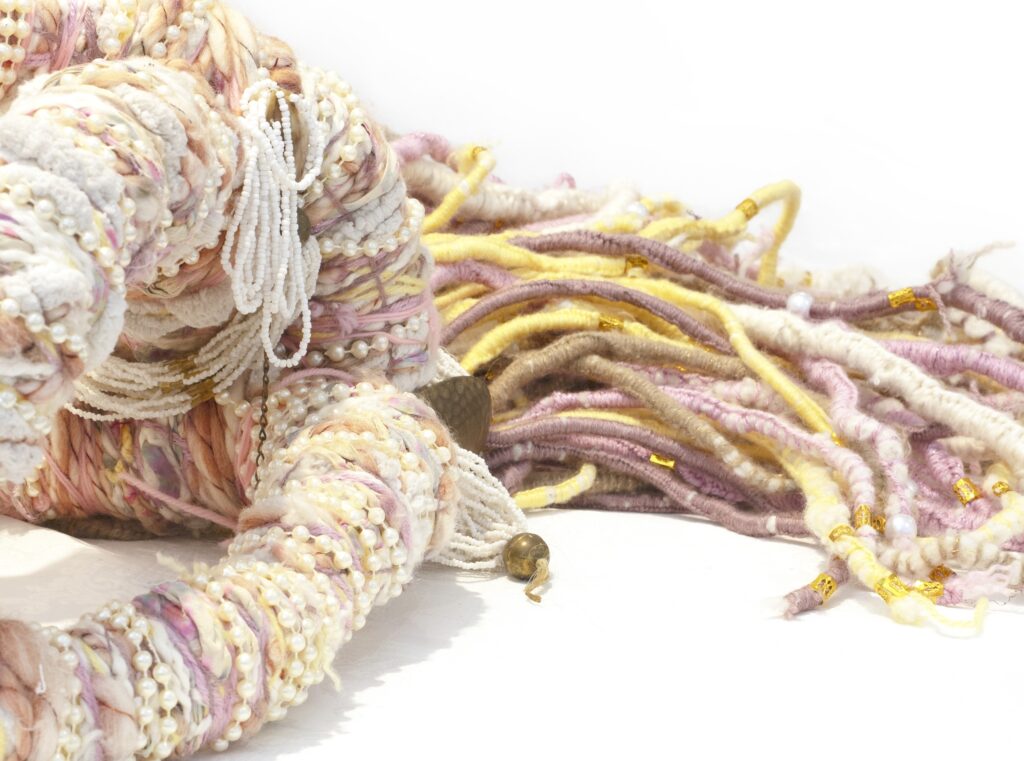
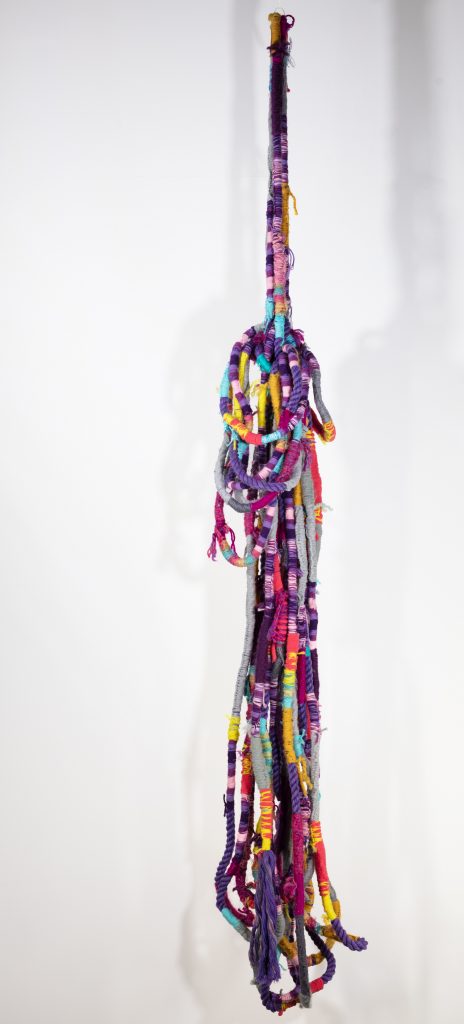
Caribbean Friendship Bracelet reads like hair before you read it as sculpture.

Extensions of rope; wrapped, woven, tied, and embellished with recycled beads, zip ties, ribbon, lace, tape, and bottle-cap bobbles, pull you in with color first. Hue as lure. Texture as invitation. Then the work turns.

These forms stand in for natural hair: bold, whimsical, and loaded. They open a door to conversations people often avoid, microaggressions, stereotypes, implicit bias, carried in something as intimate and public as hair.

Imagine, hair. The elusive, coveted “good” hair.
On some days and for some people, that is my hair.
Or was. Or can be.
But you should know by now—Don’t. Touch. My. Hair.

This piece holds more than my hand. I invited the community into the studio, five people wrapping yarn, recycled sari thread, ribbon onto rope. We worked side by side, talking through the trials and negotiations of our hair. Their gestures live in the surface. Their stories are embedded in the tension of every wrap.

It’s not just a sculpture. It’s a collective record.


Miami Fiber Triennial: Exterior Interventions — Place as Material

June 11 – July 23, 2026
Threading the City: America250
Miami-Dade County Cultural Affairs / National Endowment for the Arts

In Miami, the work moves outward.

Fiber enters the city as a material system—bound to labor, migration, extraction, and care. It meets weather, infrastructure, and the public not as decoration, but as evidence.

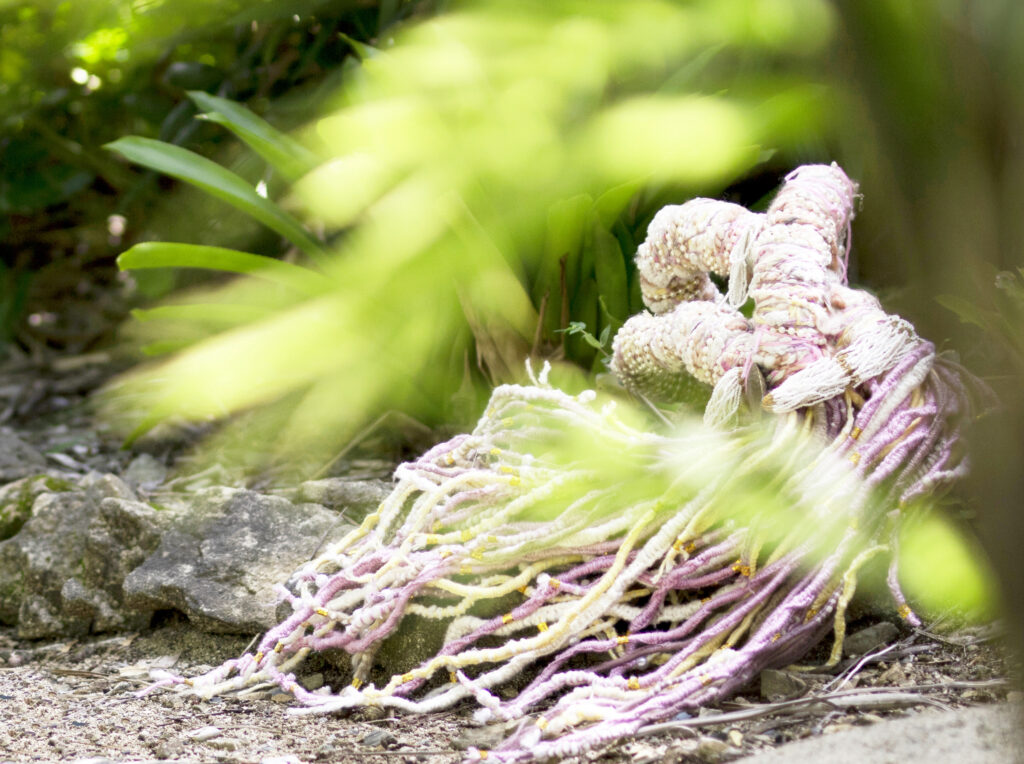
As a place-based artist, I begin by walking—listening, foraging. Plants, seed pods, shoreline debris. Marine waste becomes material, but also record, carrying the imprint of tide, trade, and time.

Through weaving and knotting, I don’t transform these elements—I bring them into relation. Each piece is a conversation with the land and sea, shaped by what is revealed and what resists.

My practice moves across gardening, foraging, assemblage, weaving, moving image, sound, and installation because the story itself is layered.

Rooted in African diasporic knowledge and the weight of colonial and environmental memory, the work navigates inheritance and rupture—what has been preserved, buried, and what continues to surface.

Within the frame of America250, the work traces what has been built—and at what cost.

What does the land remember?
What have we taken—and what remains?
What continues to speak, whether acknowledged or not?


Across both exhibitions, the thread is clear:

Hair. Rope. Vine. Line.
Each one a carrier.

Of touch.
Of boundary.
Of history that refuses to stay hidden.

If you meet the work this June, stand close, but understand what it asks of you.
Threads of Devotion: The Book of Kells

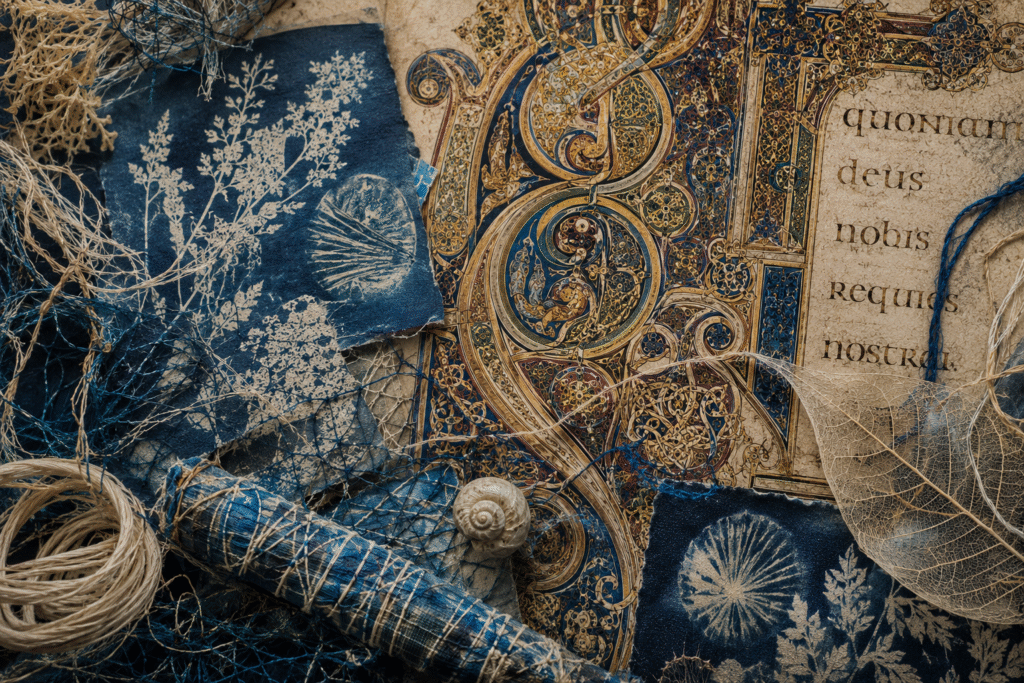
Reading about the new research surrounding the origins of the Book of Kells brought me back to the time I spent studying its pages last summer. Scholars are now reconsidering whether the manuscript may have originated in the Pictish monastery of Portmahomack in Scotland rather than solely within the Irish tradition it has long been associated with. What stayed with me most was the discussion around material process, vellum making, pigments, carving, ornament, and the close relationship between labor, devotion, and land.

While reading, I found myself thinking about how the Book of Kells moves beyond manuscript tradition and becomes something deeply tied to material knowledge and human touch. The layering of spirals, botanical forms, animals, symbols, and ornament carries a sense of accumulated care and attention over time. It also made me reflect on my own interest in wrapping, knotting, cyanotype, marine debris, and plant knowledge as ways materials can hold memory.

The manuscript is a reminder that making has long been connected to preservation, ritual, and the passing of knowledge across generations. Even centuries later, these works continue to speak through their materials as much as through their imagery.

Salvage Choir: Mask #1

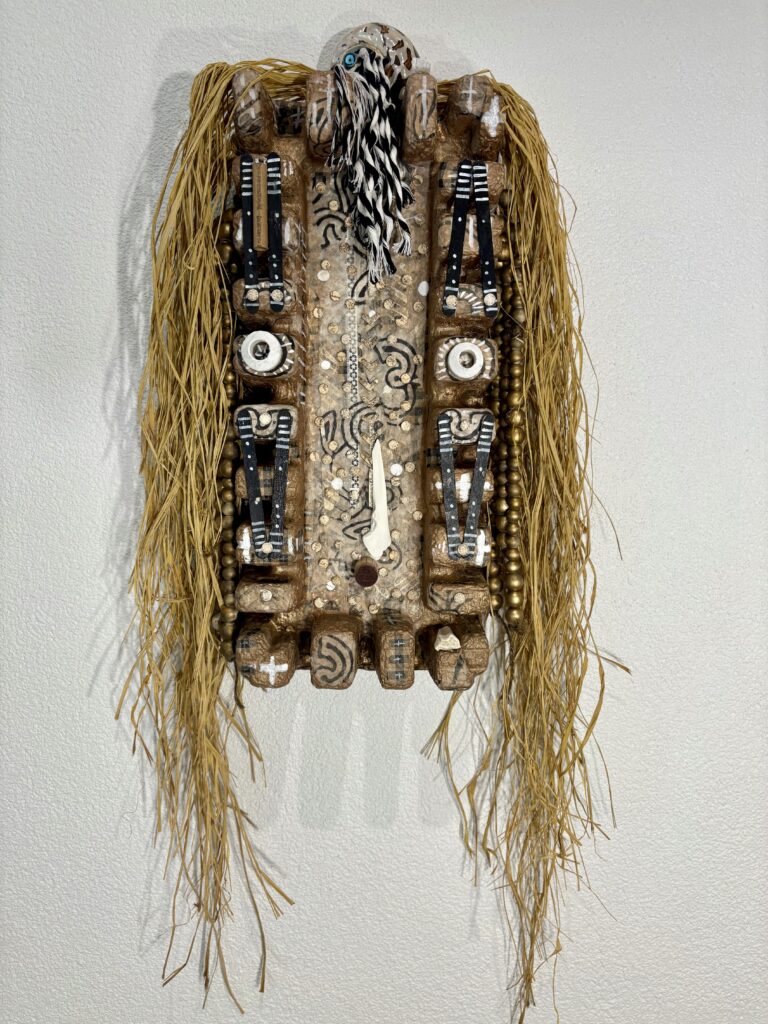
This mask began as fragments, discarded cardboard, envelopes once carrying bills, wine This one began with what was closest at hand, recycled cardboard, an envelope already opened, fragments of mono-printed deli paper. A wine cork, a piece of bone, shells still carrying salt. Nothing chosen for perfection, only for presence.

I built it through layering, raffia, yarn, string, wood beads, binding each material until it settled into place. Acrylic paint moved across the surface like a seal, then a reveal. Small elements, pop sticks, wood chips, a shard of selenite became both structure and quiet signal.

The process was intuitive, almost call-and-response. Add, layer, remove, pause. Listen. Adjust.

This first mask holds the origin of the series: a gathering of discarded things finding voice together. Not polished, not resolved but awake. A vessel of protection, memory, and becoming.

Octopus Work

The studio has been loud lately, not in sound, but in pull.

I’m working across multiple series at once, moving from one piece to another, then back again. Rope on one table. Foraged material drying in the corner. A vessel half-bound. A line of thought that won’t sit still. It feels a little ADHD in the studio, attention splitting, doubling back, chasing sparks before they cool.

It’s a gift and a curse.

Focus, for me, doesn’t look like a straight line. It looks like orbit. One piece unlocks another. Finishing something doesn’t close it, it opens a door. I’ll tie off one work and immediately see where it wants to go next. So I follow it, even if it means holding five things at once.

Right now, I’m in that stretch, finishing, resolving, pushing pieces to their edge while new ideas keep interrupting. I don’t fight it. I work like an octopus, reaching, holding, testing, building across everything all at once.

All of it is moving toward my solo show at Cane Roots Gallery in Christiansted, opening later this year. The work is rooted here, in St. Croix. New rhythms. New materials. New material histories. What the land offers. What the sea leaves behind. What the island reveals over time.

There are not enough hours in the day to bring every idea into the light. I’ve had to accept that. Some things will wait. Some will evolve. Some will never be made and that’s part of the practice too.

But what is here, what is becoming, is enough.

Each piece carries the imprint of this moment of working in motion, of holding many threads, of trusting that even in the scatter, there is a pattern forming.

I just have to keep my hands in it.

The Work Beneath the Work

There is a kind of work that happens before the work.

It doesn’t photograph well.
It doesn’t post.
It doesn’t announce itself as progress.

It looks like walking.
Reading.
Sitting with something that hasn’t found its form yet.

It looks like silence.

I’ve learned not to rush that space anymore.
The in-between is not empty.
It’s where things are rearranging—quietly, stubbornly, beneath the surface.

For a long time, I thought sustaining a creative life meant producing constantly.
Keeping pace.
Keeping up.

But that’s not what holds.

What holds is the ability to return.
To come back to the work without ceremony.
Without perfection.
Without waiting to feel ready.

To return when it’s unclear.
When it’s slow.
When it feels like nothing is happening.

Because something is always happening.

These days, I ask myself simpler questions:
What is my practice asking of me right now?
What is the smallest way I can show up today?

And I listen.

Making room has become part of the work.
Not a pause from it,
but the place where it begins.

The Color Purple

If you know me, you know how much I love the color purple.

Not just for its beauty, but for what it holds. Purple has always felt like something I move with, somewhere between earth and spirit, between the everyday and something more ancient. And yes… maybe a little bit of Prince lives in that feeling too, the way he made purple into a world you could step into.

Tyrian Purple carries that same weight in a very real way. A color once extracted with time, labor, and devotion. A color that signaled power, but also process, something earned, something made slowly.

Watching this video, I kept thinking about material and meaning. How something so small can carry so much history. How color itself can be a record, of place, of bodies, of hands at work.

Press play. Let it unfold.

Stitching Care Into the World: Knit for Food 2026

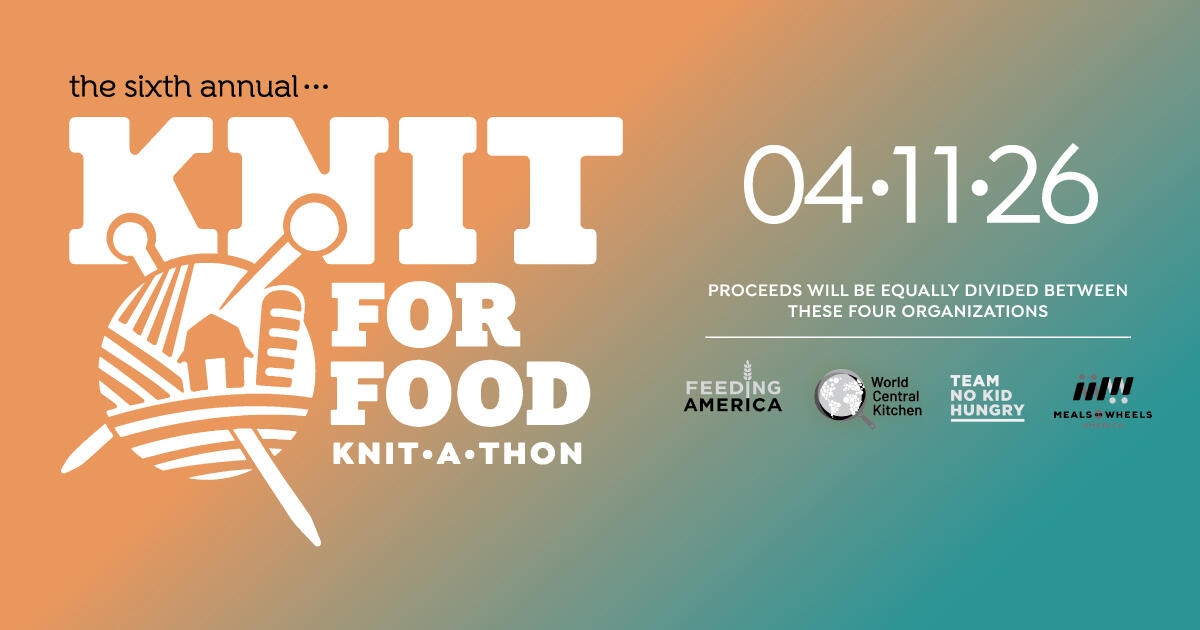
On April 11, 2026, knitters around the world will gather for the Knit for Food Knit-a-thon 2026, a 12-hour knitting marathon raising funds to fight food insecurity.

Participants can knit for the full twelve hours, join for a few rows, or simply donate. Funds raised will be shared equally among Feeding America, World Central Kitchen, No Kid Hungry, and Meals on Wheels.

Fiber has always been a language of care. Stitch by stitch, makers gather across distances, using their hands to support something larger than themselves.

If you knit, consider joining the marathon—or support the effort here:
https://givebutter.com/knitforfood26

Sometimes the smallest stitches help hold the world together.

Breathing Room

April is quiet.

One show, Expressive Creative Soul 2026 at Bridge Art Gallery and the rest is space.

No rush. No stacking deadlines. Just time back in the studio.

Focus feels different here. Slower. Sharper.
I can sit with an idea long enough to see if it holds.
Follow a thread without forcing where it ends.

There’s work forming, nothing loud yet.
Just materials shifting, small decisions adding up.

This isn’t a pause.
It’s pressure in the right place.

Less noise.
More making.

Studio Conversations: Watch the Replay

I recently joined Bridge Arts Gallery for an Expressive Creative Soul artist talk.

It was a chance to share a little about the work behind the work—my materials, the stories woven into them, and how fiber becomes a language for memory, protection, and repair.

If you missed the live conversation, the replay is now available.

Pour a cup of tea, settle in, and spend a little time in the studio with me.